期刊介绍
期刊导读
- 12/13科技论文论文格式排版(科学论文排版)
- 12/09科技论文论文题目(科技论文的题目)
- 12/07科技论文具有哪些特征
- 10/22为芦笋种植“开处方”,潍坊的科技特派员把论
- 10/13喜讯!青岛地质院何鹏被授予“优秀科技工作者
「AI+磁共振成像」研究进入爆发期:沈定刚教授(2)
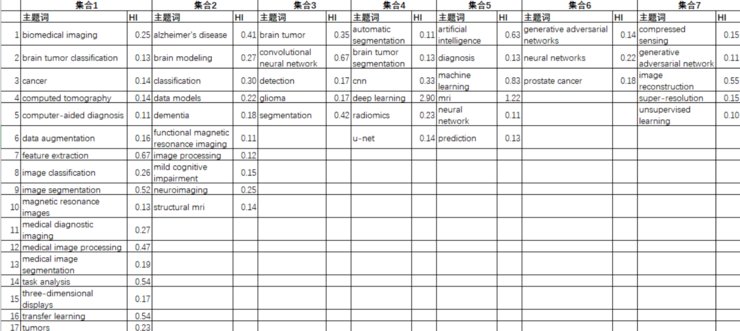
在上述分析的基础上,再利用CiteSpace对论文数据集及其参考文献集合进行分段分析,并获得该领域每个时间段内的主要的热点子领域(方向),如图4-图7所示。
Convolutional neural network是大部分研究机构论文中出现频次最高的主题词,其中哈佛大学、帝国理工学院和电子科技大学三所学校的论文中出现该主题词的频次最高。
GIBSON, E., LI, W. Q., SUDRE, C., et al. 2018. NiftyNet: a deep-learning platform for medical imaging. Computer Methods and Programs in Biomedicine, 158, 113-122.
CHEN, K. T., GONG, E. H., MACRUZ, F. B. D., et al. 2019. Ultra-Low-Dose F-18-Florbetaben Amyloid PET Imaging Using Deep Learning with Multi-Contrast MRI Inputs. Radiology, 290, 649-656.
ORTIZ, A., MUNILLA, J., GORRIZ, J. M. & RAMIREZ, J. 2016. Ensembles of Deep Learning Architectures for the Early Diagnosis of the Alzheimer's Disease. International Journal of Neural Systems, 26, 23.
磁共振成像(Magnetic Resonance Imaging, MRI)是现今临床医学诊断的重要手段之一,但如何提高成像技术、应用场景等成为该领域近来的热门研究问题。
Cluster 1 #0 prostate cancer前列腺癌
YANG, G., YU, S. M., DONG, H., SLABAUGH, G., et al. 2018. DAGAN: Deep De-Aliasing Generative Adversarial Networks for Fast Compressed Sensing MRI Reconstruction. Ieee Transactions on Medical Imaging, 37, 1310-1321.
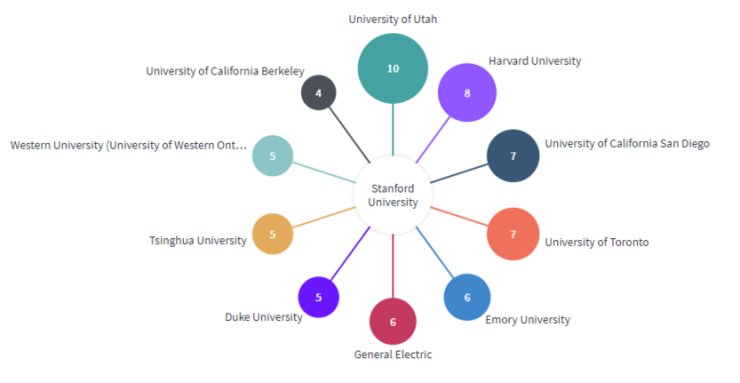
图9 斯坦福大学产出论文的主要合作机构
HAN, Y., YOO, J., KIM, H. H., SHIN, H. J., SUNG, K. & YE, J. C. 2018. Deep learning with domain adaptation for accelerated projection-reconstruction MR. Magnetic Resonance in Medicine, 80, 1189-1205.
HAN, Y., SUNWOO, L. & YE, J. C. 2020. k-Space Deep Learning for Accelerated MRI. Ieee Transactions on Medical Imaging, 39, 377-386.
Cluster 5 #4 hybrid deep magnetic resonance fingerprinting混合深度磁共振指纹
图7 深度学习时代下的磁共振成像领域共被引聚类分析(2021-2022)
DENG, Y., REN, Z. Q., KONG, Y. Y., BAO, F. & DAI, Q. H. 2017. A Hierarchical Fused Fuzzy Deep Neural Network for Data Classification. Ieee Transactions on Fuzzy Systems, 25, 1006-1012.
在该报告所引用的数据源中,ESI数据库提供了研究前沿(Research Fronts)数据,通过对最近5年内引用率最高的论文之间进行共被引聚类,识别由这些共被引论文聚类形成的集合,将这些集合定义了研究前沿RF。
SAJJAD, M., KHAN, S., MUHAMMAD, K., et al. 2019. Multi-grade brain tumor classification using deep CNN with extensive data augmentation. Journal of Computational Science, 30, 174-182.
AGGARWAL, H. K., MANI, M. P. & JACOB, M. 2019. MoDL: Model-Based Deep Learning Architecture for Inverse Problems. Ieee Transactions on Medical Imaging, 38, 394-405.
LEYNES, A. P., YANG, J., WIESINGER, F., et al. 2018. Zero-Echo-Time and Dixon Deep Pseudo-CT (ZeDD CT): Direct Generation of Pseudo-CT Images for Pelvic PET/MRI Attenuation Correction Using Deep Convolutional Neural Networks with Multiparametric MRI. Journal of Nuclear Medicine, 59, 852-858.
2013-2015年文章数量还处于零星增长阶段,2016-2017年发文量增长明显,但仍相对为低位,而从2018年起的近五年里则呈现了爆发增长的趋势,并且增长率越来越高。
Cluster 8 #7 deep independence network analysis深度独立网络分析
图4 深度学习时代下的磁共振成像领域共被引聚类分析(2013-2016)
KAMNITSAS, K., LEDIG, C., NEWCOMBE, V. F. J., et al. 2017. Efficient multi-scale 3D CNN with fully connected CRF for accurate brain lesion segmentation. Medical Image Analysis, 36, 61-78.
WACHINGER, C., REUTER, M. & KLEIN, T. 2018. DeepNAT: Deep convolutional neural network for segmenting neuroanatomy. Neuroimage, 170, 434-445.
HAZLETT, H. C., GU, H. B., MUNSELL, B. C., et al. 2017. Early brain development in infants at high risk for autism spectrum disorder. Nature, 542, 348-+.
图8 哈佛大学产出论文的主要合作机构
图13 复旦大学产出论文的主要合作机构
Cluster 6 #5 unified multi-channel classification统一多通道分类
来自帝国理工学院的Rueckert, Daniel教授,在各影响力指标上都处于所分析对象中的最高数值。
MARDANI, M., GONG, E. H., CHENG, J. Y., et al. 2019. Deep Generative Adversarial Neural Networks for Compressive Sensing MRI. Ieee Transactions on Medical Imaging, 38, 167-179.
文章来源:《中国科技论文》 网址: http://www.zgkjlwzz.cn/zonghexinwen/2022/0705/847.html